
5 episodes

How to Dominate Manufacturing in the US | Chris Power, Hadrian
Chris Power, Founder and CEO of Hadrian, tells host Ti Morse that scaling US manufacturing means building capacity ahead of contracts, operating with an 80% risk of death, and sprinting through one-way-door capex bets. He explains how GPU-style modular factory stations let Hadrian share 80% of capex across programs, and recounts a vendor defect that nearly killed the company until 30 engineers fixed it in four weeks. Power details growing from 725 to 1,325 employees in four months via 30-40 person modular teams, teaching venture investors his cost accounting, and building government trust by giving policy advice for 2.5 years before bidding. He argues CEOs should maximize organizational velocity over prediction and manage energy by acting on hard decisions immediately.Sep 21, 2026 · 1:18:49 · 10K views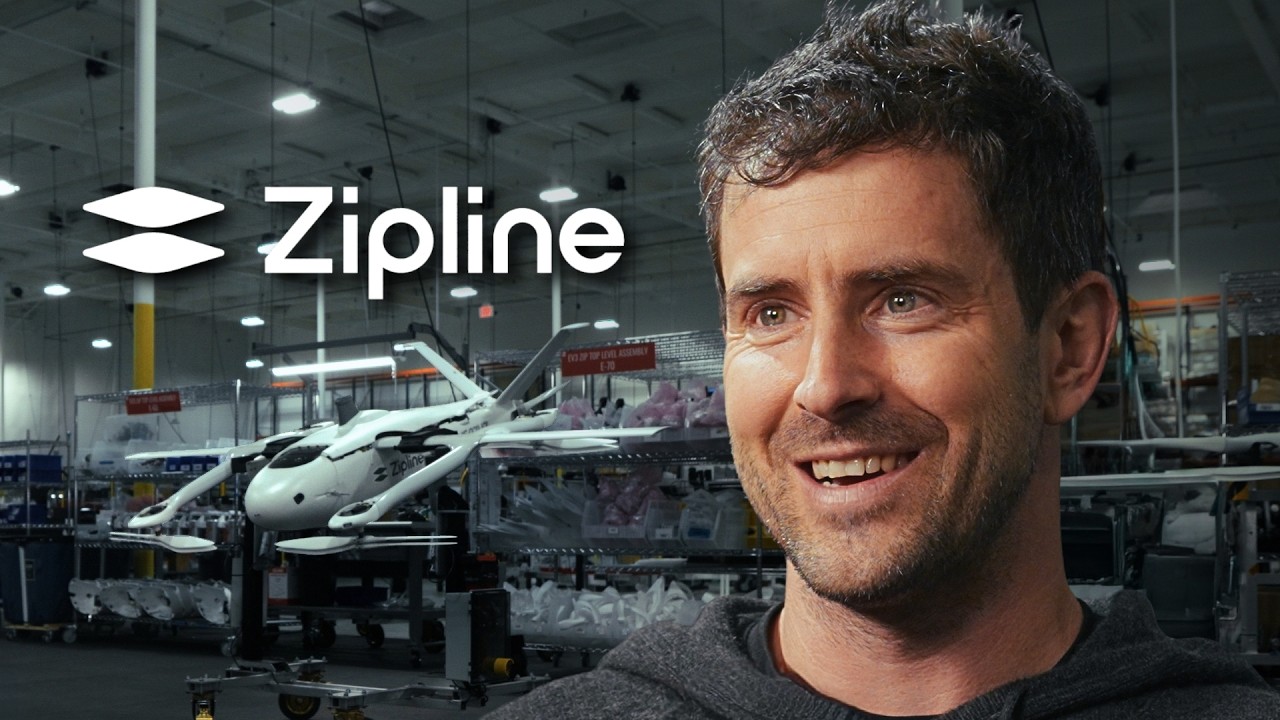
1 Million Drone Deliveries a Day by 2028 | Keller Cliffton, Zipline
Zipline Co-Founder and CEO Keller Cliffton tells Ti Morse how an Uber Eats partnership demanding 1 million drone deliveries a day within 2.5 years forced Zipline to discard its operating plan six months after setting it. He argues hardware companies are chains of 30 multiplied disciplines where one failure makes the company a zero, producing shifting existential crises from tariffs to maintenance backlogs. Because customers want 'teleportation,' not drones, Zipline is artificially constraining home sign-ups while doubling factory capacity originally sized for 20,000–40,000 aircraft a year—Cliffton needs five times that. He says 5.5 billion annual US instant deliveries could become 55 billion at observed behavior, and closes arguing robotics will 'give the Earth back to humans.'Sep 14, 2026 · 41:26 · 17K views
Starting a Solid Rocket Motor Factory from Scratch | Ethan Thornton, Mach Industries
Ethan Thornton, founder and CEO of defense startup Mach Industries, argues that product iteration speed—not raw performance—is what wins for the West against China's manufacturing scale. He walks through scaling a solid rocket motor factory toward hundreds of thousands of units a year, the 'baking not plumbing' curing process, and vertically integrating jet engines, radars, and warheads to secure surge capacity. He explains block redesigns every three months, Capex-light/Opex-heavy economics, and function-based orgs that keep small teams moving fast. He also details killing hydrogen despite it being 100% of revenue, moving the company from Austin to LA, and lessons on leadership failure and bouncing back from mistakes.Sep 2, 2026 · 1:49:34 · 91K views
Manufacturing 1 million drones a year | Olaf Hichwa, Neros
Olaf Hichwa, co-founder and CTO of drone maker Neros, says the company now builds over 1,000 Archers a week and plans to reach a 130,000-drone annual run rate by December and one million drones a year by 2028 from its new 250,000 sq ft factory. In the episode he explains why drones cause roughly 70% of casualties in Ukraine, why Neros designs for operators rather than government specs, and how Archer AI lets a drone lock onto a target and strike even after losing comms or GPS. He also details the Bandit interceptor, the decision to vertically integrate components, and lessons from a Chinese production line making 2,000 Russian kamikaze drones a day, arguing the West must rebuild its drone industrial base to maintain credible deterrence.Aug 11, 2026 · 1:06:28 · 38K views
Sam Altman - How to Start a Startup
Sam Altman, CEO of OpenAI, explains how AI has transformed startup building, arguing that the exponential progress of models and the ability to do more with smaller teams make this an unprecedented time for founders. He describes trusting exponentials, operating in chaotic environments, and learning to enjoy painful experiences as key to resilience. Altman details OpenAI's mission to create abundant, cheap, and decentralized intelligence, with current bottlenecks being transistors and electrons (chips and energy). He shares stories of buying massive compute, the world tour after GPT-4 launch that visited 28 countries in 35 days, shutting down promising projects like Sora to focus on coding agents (Codex), and how he texts 300-400 people daily to maintain context. Altman contrasts real trends (deep enduring usage like ChatGPT) from fake trends (hype without sustained use) and emphasizes that the joint-stock company was a pivotal invention for incentive alignment. He also reflects on Google's failure to capitalize on their AI lead, his own undershooting on compute investments, and the importance of asking for what you want, illustrated by the kamikaze mission that made Codex beat…Jul 25, 2026 · 1:09:39 · 390K viewsChris Power, Founder and CEO of Hadrian, tells host Ti Morse that scaling US manufacturing means building capacity ahead of contracts, operating with an 80% risk of death, and sprinting through one-way-door capex bets. He explains how GPU-style modular factory stations let Hadrian share 80% of capex across programs, and recounts a vendor defect that nearly killed the company until 30 engineers fixed it in four weeks. Power details growing from 725 to 1,325 employees in four months via 30-40 person modular teams, teaching venture investors his cost accounting, and building government trust by giving policy advice for 2.5 years before bidding. He argues CEOs should maximize organizational velocity over prediction and manage energy by acting on hard decisions immediately.
Chris is the Founder and CEO of Hadrian, one of the fastest growing manufacturing startups in the United States. Hadrian has opened six factories since it was founded in 2020 with the latest being 2.2 million square feet. Hadrian: https://hadrian.co Chris on X: https://x.com/2112Power Ti on X: https://x.com/ti_morse Timestamps: 0:10 How to scale manufacturing in the US 1:42 Building ahead of contracts 4:21 Burn rate & execution risk 6:40 Bets that aren’t risky to you but are risky to everyone else 8:34 Scaling capacity 10:45 Operating with an 80% risk of death 13:10 Sprinting through 1-way doors 16:51 “Sometimes you gotta roll a hard 6” 18:37 Constructing a new factory 21:45 Learning how to build factories 28:14 Surviving company killing events 32:12 Radically pulling forward timelines 37:13 How financing changes as you scale from $1M revenue to $1B revenue 38:53 Growing from 725 to 1,325 employees in 4 months 43:00 Deciding which contracts to go after 45:33 What’s stopping you from growing faster? 50:02 “Just f*cking do it” 53:23 Designing the finance side of the business 56:51 Educating investors on manufacturing and capex heavy businesses 59:08 Deciding which competitive advantages to optimize for 1:02:08 Building trust with government partners 1:04:54 False doors 1:09:12 Figuring out the highest leverage activities 1:11:04 Investing in velocity 1:13:59 Energy management